Unfortunately, applying “simple” tools at the expense of tools with considerably more value (and really not much more complexity or difficulty) doesn’t cut it.
Statistical Process Control (SPC) charts allow timely detection of assignable causes of process changes (e.g. shifts, trends, variation). This allows root causes to be determined and allows the production team to take corrective actions before product performance is adversely impacted.
Proper use of SPC identifies and eliminates “special cause” sources of variation. To achieve desired process capability, sources of “common cause” variation may need to be identified as well, using tools such as Design of Experiments to develop process understanding and predictive models that explain the source of the unwanted variability.
Reducing variability in key product characteristics is vital to achieving high levels of quality and reliability. Unfortunately, the focus of many quality efforts is the use of inspection methods to simply ensure that products conform to specifications.
The glaring problem with this is the fact that many product failures occur despite everything being “in-spec.” How much of the billions spent every year in warranty expense in the auto industry alone do you think stems from “out-of-spec” parts? (Answer: Negligible)
Despite its proven necessity as a tool for controlling processes and minimizing variation, SPC is generally unappreciated today. Many SPC programs have fallen victim to short-sighted cost cutting. Furthermore, tremendous misuse and misapplication of SPC exists due to a lack of understanding of important fundamentals as well as the failure to adopt newer charting techniques that accommodate common modern manufacturing systems. Some of these issues have been addressed in prior articles and others will be addressed in future articles.
While a need for a return to the rigorous adoption of proper SPC techniques is in order, many advocate the replacement of SPC with more simplistic approaches such as “Pre-Control.” Unfortunately, in a manufacturing world of increasing complexity, and with a global market demanding the highest quality and reliability, applying “simple” tools at the expense of tools with considerably more value (and really not much more complexity or difficulty) doesn’t cut it.
What is Pre-Control?
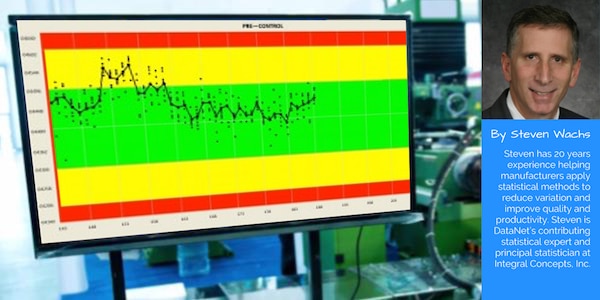
This article assumes that the reader is familiar with the basic elements of pre-control. Essentially, pre-control involves inspecting units and adjusting the process and subsequent sampling procedures based on where the measurements fall relative to the specification limits. Pre-Control focuses on individual measurements and assesses whether process adjustments are justified based on probabilities (which depend on assumed distributions and the process location). Charting is not required for pre-control since decisions are based simply on the zone in which the measurements fall.
Problems with Pre-Control
Pre-Control procedures have many serious disadvantages compared to Control Charts. Several are briefly described below:
- Pre-control begins with a set of assumptions (that drive the probabilities and reaction criteria) that in practice are rarely true:
- Pre-control does not concern itself with understanding or estimating process characteristics vital to achieving product quality (process average and process standard deviation)
- Because pre-control often does not employ charts, any obvious patterns over time that indicate trends or cycles are not easily detected.
- Pre-control utilizes individuals values as opposed to statistics like sample averages. As discussed at length in an earlier article, the use of individual values provides little power to detect anything but large process changes. So, while the process may be changing and adding harmful variation, pre-control is powerless to detect it.
- Pre-control is reactionary in nature and does not focus on finding or eliminating the sources of process changes. Rather, it encourages ongoing efforts by operators to make frequent adjustments rather than promoting attempts at eliminating sources of variation.
- Careful and comprehensive analyses of pre-control practices by qualified statisticians have concluded that its use will likely lead to unjustified and unnecessary “over-control” of the process, which actually leads to increased variability.
Pre-control is a poor substitute for statistical process control charts. Rather than enabling manufacturers to conquer and control unpredictable processes (and ultimately improve them), they perpetuate the obsolete mindset of trying to inspect quality into a product. It also relies on unjustifiable assumptions that may lead to ineffective or harmful reactions.
Steven Wachs, Principal Statistician
Integral Concepts, Inc.
Integral Concepts provides consulting services and training in the application of quantitative methods to understand, predict, and optimize product designs, manufacturing operations, and product reliability. www.integral-concepts.com

Our Fact Checking Process
We prioritize accuracy and integrity in our content. Here's how we maintain high standards:- Expert Review: All articles are reviewed by subject matter experts.
- Source Validation: Information is backed by credible, up-to-date sources.
- Transparency: We clearly cite references and disclose potential conflicts.
Our Review Board
Our content is carefully reviewed by experienced professionals to ensure accuracy and relevance.- Qualified Experts: Each article is assessed by specialists with field-specific knowledge.
- Up-to-date Insights: We incorporate the latest research, trends, and standards.
- Commitment to Quality: Reviewers ensure clarity, correctness, and completeness.