Manufacturing organizations are operating under unprecedented pressure. Customer expectations continue to rise. Regulatory requirements continue to expand. Labor shortages persist. And manufacturing systems are generating more data than ever before, yet many organizations still have more data than they can effectively use.
For decades, Statistical Process Control (SPC) has served as the foundation of manufacturing quality, providing the statistical rigor, accountability, and governance necessary to distinguish meaningful process variation from normal operating behavior. That role remains essential. But today’s operations involve thousands of interconnected variables and volumes of data that traditional methods alone were never designed to analyze.
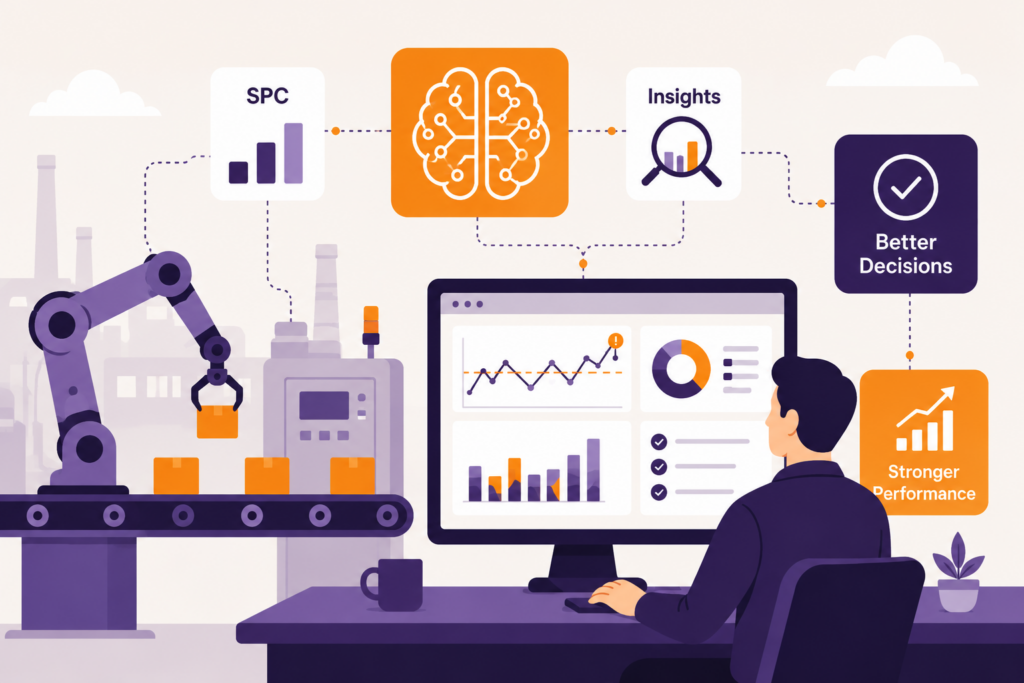
This is where AI enters the conversation. The answer isn’t replacing SPC. It’s strengthening SPC while extending its analytical reach through AI.
The future of manufacturing quality is not SPC or AI. It’s SPC and AI working together within a governed framework that balances visibility, accountability, and intelligence.
Why Real-Time Visibility Changes the Equation
Historically, quality information arrived after production events had already occurred. Operators completed inspections, engineers reviewed reports, and corrective actions followed, while production kept moving. Every minute between a process deviation and its detection increases the potential impact on quality, cost, throughput, and customer satisfaction.
Real-time quality flips that model. Instead of discovering problems after production has been affected, teams gain visibility into process behavior while operations are still running. Quality engineers spend less time gathering data and more time on actual exceptions. Operations, maintenance, engineering, and quality all work from the same information at the same time.
SPC Still Does What It’s Always Done Best
SPC isn’t a legacy methodology headed for retirement. It’s the operational foundation modern quality systems are built on. Its value goes well beyond control charts:
- Establishes decision boundaries
- Supports accountability
- Creates transparency
- Enables auditability
In regulated industries especially, quality decisions have to be explainable, actions have to be documented, and accountability has to be clear. SPC provides that naturally, and as complexity increases, that governance becomes more valuable, not less.
Where SPC Runs Into Its Limits
Modern operations generate more variables than traditional control charts were built to handle. A single process might involve dozens of interacting factors, temperature, humidity, material variation, machine settings, supplier performance, and the challenge stops being about monitoring one variable and becomes about understanding how they all interact.
That’s the dimensionality problem, and it’s also where SPC’s retrospective nature starts to show. SPC tells you what happened. Increasingly, quality leaders want to know what’s likely to happen next.
That’s where AI complements SPC rather than competing with it.
Four Ways AI Actually Moves the Needle
Skip the hype and focus on outcomes. The AI applications delivering real value in quality fall into four categories:
Predictive analytics: identifying patterns tied to process drift, equipment degradation, and emerging risk before traditional monitoring catches them.
Multivariate pattern recognition: surfacing relationships across large, interconnected datasets that traditional methods can’t untangle.
Root-cause acceleration: helping teams investigate faster by surfacing likely contributing factors and relevant historical patterns.
Natural-language access: letting operators, engineers, and managers query quality information conversationally instead of digging through dashboards.
The distinction that matters: SPC governs decisions. AI extends visibility.
A Framework, Not Just a Tool Stack
Predictive quality isn’t just a technology add-on. It’s a layered operating model, with governance wrapped around every layer:
- Operational data: sensors, machines, inspection systems, ERP, MES
- Statistical Process Control: stability, compliance, accountability
- Artificial intelligence: predictive analytics, anomaly detection, root-cause support
- Human decision-making: operators, engineers, and leaders acting on the signal
Technology informs. People decide. Governance ensures accountability. That order doesn’t change.
The Mistakes That Undermine AI Initiatives
A few patterns show up again and again in failed AI-in-quality efforts:
- Deploying AI without governance creates accountability gaps
- Black-box outputs without explainability erode trust
- Weakening SPC foundations removes the controls everything else depends on
- Skipping team preparation limits adoption
- Underestimating the organizational change required stalls progress
The benefits of AI in quality are conditional. They depend on disciplined integration, not just deployment.
Where This Leads: Process Optimization
The path to predictive quality generally moves through four stages of maturity: reactive quality, real-time visibility, predictive quality, and finally process optimization, where quality, operations, engineering, and intelligence work together continuously rather than in response to problems.
Getting there starts with a few honest questions:
- Do we have real-time visibility into process performance?
- Are quality decisions supported by timely insight?
- Are accountability structures clearly defined?
- Do we have a governance framework for AI-enabled decision support?
- Are we positioned to move from reactive to predictive?
Want the full breakdown?
This post only scratches the surface. Our full guide, The Quality Manager’s Guide to Predictive Quality, goes deeper into the Predictive Quality Framework, the five requirements for success, and a myths-vs-reality breakdown of what AI can and can’t do for your quality program.