Quality Advisor

Default White Guide

SPC DEMO

Minimize Production Costs, Quickly Detect Issues, and Optimize Your Product Quality

Don’t miss out! Book a demo of our specialized SPC software and unlock immediate improvements in your processes.

Run chart interpretation

To analyze run charts:

  1. Look for runs.
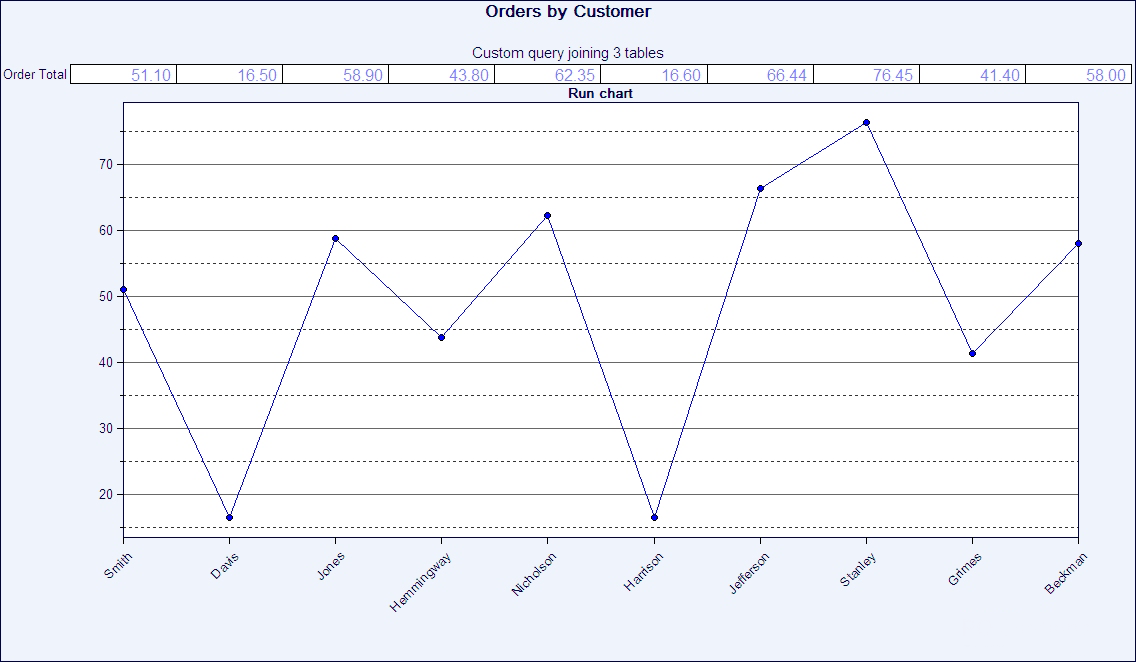
    If you find seven or more points in a row rising or falling, you have found an unusual circumstance that calls for investigation. Finding evidence of a run is neither good nor bad. It simply raises a flag that says “ask why.”
  2. Look for other nonrandom patterns.
    You may find a repeating pattern that corresponds to other data. Any nonrandom or repeating pattern is cause for investigation. If you find no unusual patterns, you may notice differences among readings. Do they swing from highs to lows or are they quite similar to each other? Further analysis by control chart is the next likely step.

To create run charts that will highlight these patterns, use software such as SQCpack.

Run chart interpretation

Quality Advisor

Default White Guide

SPC DEMO

Minimize Production Costs, Quickly Detect Issues, and Optimize Your Product Quality

Don’t miss out! Book a demo of our specialized SPC software and unlock immediate improvements in your processes.

Whiskers plot

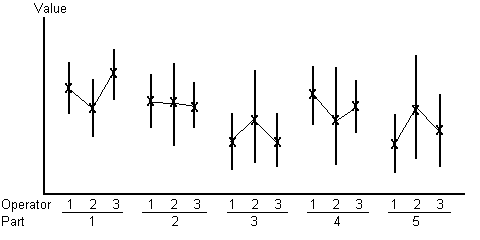
This chart shows the high and low data values and the averages by part and by appraiser. The vertical line represents the range deviation made by an appraiser on one part. This helps determine measurement consistency by an appraiser, across appraisers, and shows abnormal readings, and part appraiser interaction.

To create a Whisker plot:

  1. Plot the high and low data values and the average by part for each operator.
  2. Draw a line to connect the high value to the low value.
  3. Connect the averages for each part for each operator, as shown below.

The longer the line, the larger the deviation from the true value of each part. The Whisker-Box Plot also lets you compare the results of each operator. If one operator’s results vary greatly, the operator may need more training on the measurement techniques and practices.

Quality Advisor

Default White Guide

SPC DEMO

Minimize Production Costs, Quickly Detect Issues, and Optimize Your Product Quality

Don’t miss out! Book a demo of our specialized SPC software and unlock immediate improvements in your processes.

MSA: When should a measurement study be done?

The question has been raised multiple times: when should a measurement study be completed?The rule is very simple:Whenever a measurement is being used to assess the quality or quantity of a product, a measurement system study is required.This means that all measurement systems should be assessed statistically.Of course, some kind of priority has to be set, as it is obviously impossible to complete an assessment of every system in an organization immediately. So, we suggest the following priorities:

New measurement systems/equipment

Assessment of new equipment is a good way to ensure that it meets the organization’s needs. One of the great things about statistically assessing equipment is that the process will indicate whether different people can work effectively with the equipment. It also gives a performance baseline for the equipment, so if you experience deterioration in the equipment, the study will be able to quantify the problem.

Measurement systems/equipment being used for SPC

If the variation from the measurement system is high, then control charts will show changes in the measurement equipment, not changes in the process. So it is essential to assess measurement systems statistically prior to implementing SPC.

Since trends and changes apparent in SPC charts can come from the measurement system itself, it is important when trying to track down issues to understand the effect of measurement variation.

Measurement systems/equipment used at critical decision points

If a measurement is taken to assess whether to pass or fail a batch, it is essential that the measurement system is able to complete the task consistently and reliably.

A common comment from customers is: “We’ve been using this equipment for years and it has never been a problem. We regularly calibrate it and it has certificates. Why should we assess it?” Remember, a statistical assessment is an accurate picture of the everyday variation in measurements. Equipment can pass calibration easily and yet fail the statistical assessment. Often, measurement systems are viewed as being correct, beyond question. Don’t be blinded to this critical area of variation.

You can also use this kind of assessment in other circumstances, including:

  • Ensuring that you and your customer use similar methods of measurement;
  • Ensuring that you and your suppliers use similar methods of measurement;
  • Ensuring that different locations within the organization measure in a similar way;
  • Assessing a measurement system before and after repair;
  • Preventing measurement deterioration;
  • Ensuring that a a new tester is fully trained;
  • Assessing two different methods of testing;
  • Assessing the impact of changing environmental conditions.

In garnering these advantages from your measurement system analysis, you will find that GAGEpack provides tools that will assure that measurement studies are completed in a timely and accurate way.
Quality Advisor

Default White Guide

SPC DEMO

Minimize Production Costs, Quickly Detect Issues, and Optimize Your Product Quality

Don’t miss out! Book a demo of our specialized SPC software and unlock immediate improvements in your processes.

MSA: Measuring your measurement system with a performance curve

By Jackie Graham, Ph.D.

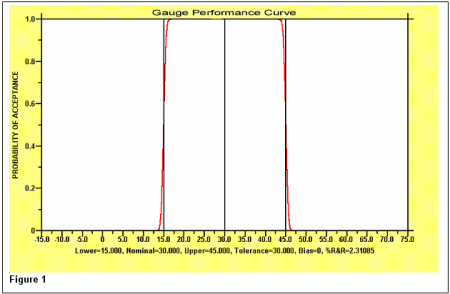
As measurement system variation increases, the probability of getting a correct value from a measurement system reduces. This concept is portrayed best by using a ‘gage performance curve.’ The example ‘gage performance curve’ shown in figure 1, demonstrates an excellent measurement system where the measurement variation is low, with an R&R (reproducibility and repeatability) of less than 10%.

Now, to explain what the chart means and how you interpret it. The x-axis shows the range of actual values of the product being measured. The y-axis shows the probability of accepting a product of any of the values using the current measurement system. The straight line in the center of the chart is the center of the specification, while the two straight lines either side of the center line represent the tolerance range. The curve represents the probability of accepting product to the tolerance. From the chart, it can be seen that if the true product value is 30 (the center of the specification) the chance of its being accepted using the measurement system studied is 1.0 or 100%, as it should be. If the product value is 10, well below the lower specification, the chance of its being accepted is 0 or 0%, again as it should be, since it is well below specification. Although a value of 14 is below the lower specification (15), the curve shows it has a small chance of being accepted in error. The curve shows that a product with a value of 16 has a high chance of being accepted, ideally this would be 100%, but due to the variation in the measurement system it has a slight chance of being rejected.

Ideally, the ‘gage performance curve’ should show a reading of 0% up to the lower specification, go straight to 100%, and remain at 100% to the upper specification, then go back to 0%. However, no measurement system is perfect; there will always be some chance of accepting or rejecting product in error, graphically depicted by the gage performance curve.

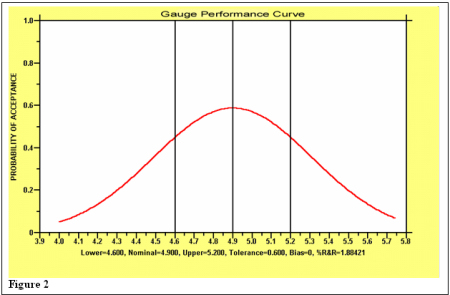
A measurement system with extremely high variation, say with an R&R of 300% of the tolerance, (generally the maximum acceptable R&R is 30%) would show a very different ‘gage performance curve.’ Figure 2 depicts such a curve.

This chart graphically demonstrates the impact of a highly variable measurement system. In this example, if the product has a value in the center of the specification it only has about a 60% chance of being accepted. This means that when the reading is taken from the measuring equipment, it has a 60% chance of producing a result inside the specification, and a 40% chance of producing a result outside the specification. As the curve shows, product that is way outside the specification still has a chance of being accepted. In this case, the specification is 4.6 to 5.2, yet product could be accepted from less than 4.00 to more than 5.75. This is quite a range when compared to the specification range of 0.6! If you think this kind of measurement system does not exist, unfortunately you are wrong. They occur all too frequently!

When setting up a measurement system it is essential to ensure that it is adequate for its purpose. The only way this can be assured is by completing an R&R study. If this is not completed, expect to accept product that is out-of-specification, and to reject acceptable product in error. The costs of poor measurement systems are enormous.

So, how do your measurement systems measure up? GAGEpack allows easy assessment of measurement systems and subsequent analysis using tools like the gage performance curve. Download a free trial now.

Quality Advisor

Default White Guide

SPC DEMO

Minimize Production Costs, Quickly Detect Issues, and Optimize Your Product Quality

Don’t miss out! Book a demo of our specialized SPC software and unlock immediate improvements in your processes.

Why use MSA software?

Measurement Systems Analysis software is designed to identify the components of your measurement system which are contributing to the variation in gage measurements. Variation can come from a number of different sources, including the person using the gage, the parts being measured, the environment where the measurement is taking place, the equipment being used, and so on. MSA studies exist to discover and quantify the amount of variation coming from these different sources, so that corrective action may be taken if necessary.

Routine and properly-executed MSA studies allow users to find and correct situations where an unacceptably high amount of variance is being introduced into a measurement system. MSA software reduces the time it takes to conduct these studies while increasing the accuracy of the results.

GAGEpack linearity plot

How can GAGEpack help?

GAGEpack performs both variable and attribute gage repeatability and reproducibility (R&R) studies, calculates the uncertainty of your calibrations, and produces accuracy and stability charts.

All the relevant MSA studies that are discussed in the AIAG MSA Manual 4th edition are included in GAGEpack. Users simply enter in the data from the studies and GAGEpack handles all the calculations and generates the charts using the formulas provided by the manual. The results of the studies are stored and available for future reference or easy sharing.

Quality Advisor

Default White Guide

SPC DEMO

Minimize Production Costs, Quickly Detect Issues, and Optimize Your Product Quality

Don’t miss out! Book a demo of our specialized SPC software and unlock immediate improvements in your processes.

Stability and linearity: Keys to an effective measurement system

Steve DaumKnowing that a measurement system is stable is a comfort to the individuals involved in managing the measurement system. If the measuring process is changing over time, the ability to use the data gathered in making decisions is diminished. If there is no method used to assess stability, it will be difficult to determine the sensitivity of the measurement system to change and the frequency of the change. Calibrations and R&R studies provide some information about changes in the measurement system, but neither of these provides an accurate picture of what is happening to the measurement process over time.Stability is the key to predictability. In terms of measuring equipment, stability is determined by using a control chart. Repeated measurements are obtained using a measurement device on the same unit (frequently called a master) to measure a single characteristic over time. As measurements are taken, points within the limits indicate that the process has not changed and the prediction is made that it is not likely to change in the future.The appropriate time interval is often a major consideration when analyzing the measurement system. Knowledge of the circumstances and conditions in which the equipment is used will help identify special causes when the system is unstable. Action should be taken to make the measurement system robust to the conditions that cause instability. The more likely it is that the measurement system will change, the shorter the interval should be between measurements.

In addition to using control charts and understanding the concept of stability for the measurement system, determining the linearity of the measurement system and understanding its impact on the measured values will contribute to the effectiveness of the measurement system. Linearity is the difference in the accuracy values through the expected operating range of the equipment. The linearity can be determined by selecting parts throughout the entire operating range of the instrument. The accuracy of those parts is determined by the difference between the master measurement and the observed average measurement. The accuracy of these parts can be determined by plotting the accuracy values from the smallest size (closed position) to the largest size (open position). The linearity of the equipment is represented by the slope of a “best fit” line through these points. This best fit line is determined by using least squares regression.

If equipment demonstrates non-linearity, one or more of these conditions may exist

  1. Equipment not calibrated at the upper and lower end of the operating range;
  2. Error in the minimum or maximum master;
  3. Worn equipment;
  4. Possible review of internal equipment design characters.

Product and process conformance are determined by measurements that are taken by a measurement system. Errors in these measurements have a direct bearing on conformance as defined within the system. A clear understanding of the results of the measurement system requires an understanding of the possible error within the system. To understand this error, one needs to understand the terminology, and in particular the concepts of stability and linearity. Both stability charts and linearity plots can easily be accomplished using GAGEpack. Download a free trial today.

Quality Advisor

Default White Guide

SPC DEMO

Minimize Production Costs, Quickly Detect Issues, and Optimize Your Product Quality

Don’t miss out! Book a demo of our specialized SPC software and unlock immediate improvements in your processes.

Gentlemen, start your gages: R&R and variability

A number of factors affect the ability of a measurement system to discriminate among the units it measures. These factors can be categorized generally into those that affect central location and those that affect the variability (spread) of the measurements. Variability factors measured by repeatability and reproducibility are the more familiar, while factors related to the central location of the measurements (stability, bias, and linearity) are relatively new approaches. Both approaches may need clarification. In addition, methods of measurement must be developed along with standards for indicating their acceptability. In a series of articles, these concepts will be addressed.

The first of these will deal with repeatability and reproducibility and combining them into the R&R component. The next article will take this R&R component and calculate R&R percentages based on study variation, process variation, and tolerance. The Measurement Study (classic) typically utilizes one to three appraisers for one measuring instrument that is measuring a single characteristic. Each appraiser measures five to ten units selected from a process two or three times (replications). Before proceeding with the analysis of the study, the ranges for the replications of the measurements made by each appraiser on each part are determined and used to calculate control limits for the range chart. Then each range is checked to determine if it falls inside the limits. Those measurements that result in a range outside the limits should be excluded from further analysis or should be redone. Operative assumptions include:

  1. The measuring instrument stays in calibration (central location does not change);
  2. Appraisers use the same method of measurement;
  3. Parts are measured in the same place. (If the assumption that the parts are measured in the same place is incorrect, the possibility of within-part variation will need to be considered.)

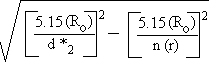
Repeatability refers to the variation in measurements for one characteristic made with one measuring instrument by one appraiser on the same part. An estimate of repeatability is obtained by first determining the average range () of the repeated measurements of the same characteristic, using the same measuring instrument for several parts. Note: if more than one appraiser is used in the study, the average range is the combination for all appraisers, e.g., [If there are three appraisers, a, b, and c, you would determine the average range using ( = a + b + c )/3]. Next, the standard deviation for the repeatability (se) is estimated by dividing   by d*2. A 99% (-2.575 < z < +2.575) interval for repeatability is determined by multiplying 5.15 by (se).Reproducibility refers to the difference in the average of the measurements on one characteristic made by different appraisers using the same measuring instrument on the same part(s). Note: if there is only one appraiser using the gage, there will be no reproducibility (appraiser variation). Again, the assumptions are that the instrument stays in calibration, the appraisers use the same method of measurement, and the part is measured in the same place. An estimate of reproducibility is obtained by determining the mean of all the measurements made by each appraiser e.g., [If there are three appraisers, a, b, and c, you would determine the average range using (= a + b + c )]. The range estimate for the operators (Ro) is obtained by subtracting the minimum i  from the Maximum i.Next, the standard deviation for reproducibility (so) is estimated by dividing (Ro) by d*2. Again, a 99% (-2.575 < z < +2.575) interval for repeatability is determined by multiplying 5.15 by (so).Since the measuring instrument is used in making the measurements, it is a contributing factor to the calculation of reproducibility. Therefore, the calculation of reproducibility needs to be adjusted by subtracting a portion of repeatability. The adjusted appraiser variation is given by:

Where:
n = number of parts used in the study
r = number of times each part is used

R&R is the combination of repeatability and reproducibility variation and frequently is considered as the total measurement variation excluding within part variation and variation in central location. R&R studies can be done easily and accurately using software products like GAGEpack.

Quality Advisor

Default White Guide

SPC DEMO

Minimize Production Costs, Quickly Detect Issues, and Optimize Your Product Quality

Don’t miss out! Book a demo of our specialized SPC software and unlock immediate improvements in your processes.

How do you interpret an R&R study?

After performing an R&R study, which can be done using software such as GAGEpack, there are a number of ways to interpret the results. Frequently, since R&R is done in response to a customer requirement, the customer will indicate how to interpret the results. The most common here is the AIAG (Automotive Industry Action Group) standards, which are based on the R&R percentage given under study results. These results may be calculated as a percent of study variation, percent of specification, or percent of process variation.

For percent of study, the process variation is based on the spread of the parts (P) determined by . This is considered a range and using the /d2 relationship, a sigma for the process is estimated. This is then used to calculate the percentages.

A second method is to use the spread of the specs (USL – LSL). Now this must be compared to the estimate of the measurement error (R&R). However, one needs to multiply the sigma of the measurement by 5.15 (old method) or by 6.0 (new method) to compare the total measurement spread with the spec spread. (An alternative method is to divide the spec range by the respective numbers given above.)

The third method uses the information from an chart on the process and characteristic being studied. In this case, enter the , the , and the sample size. This is used to estimate the process spread.

Ideally the measurement error (R&R%) is less than 10% of whatever method is used (process spread or spec spread). It is usable in some cases when the R&R percentage is between 10 and 30%. More than 30% suggests that one should not be using it. [page 60 of MSA Manual 2nd edition or page 77 of MSA Manual 3rd edition]

If the number of distinct categories is 5 or more, it can be considered a capable measurement system. Wheeler and Lyday use a concept closely aligned with distinct categories called discrimination ratio, for which greater than four is satisfactory. The differences, in a nutshell, are that the distinct categories is a truncated number (no rounding or fraction used) and the discrimination Ratio assumes that appraiser variation has been reduced to zero and carries the fractional part as well.

Variables step-by-step interpretation

Are there 100 data values (observations)?

Yes   No

Default White Guide

SPC DEMO

Minimize Production Costs, Quickly Detect Issues, and Optimize Your Product Quality

Don’t miss out! Book a demo of our specialized SPC software and unlock immediate improvements in your processes.