Quality Advisor
A free online reference for statistical process control, process capability analysis, measurement systems analysis,
control chart interpretation, and other quality metrics.

SPC DEMO
Don’t miss out! Book a demo of our specialized SPC software and unlock immediate improvements in your processes.
Capability analysis: Indices
What are the measures of process capability?
These indices show what the process is “capable” of doing. This is the six sigma range of the inherent variation of a statistically stable process. Sigma is estimated using the  /d2 formula.
What are the measures of process performance?
These indices show what a process is actually doing. This is the six sigma range of the total process variation, where sigma is usually determined by the sample standard deviation.
All of these capability indices can be calculated using software packages like SQCpack.
See also:
>> Can a process produce output within specifications?
>> Control vs capability
>> Normal data capability analysis
>> Non-normal data capability analysis
>> What is capability analysis and when is it used?
>> Learning more about capability
Quality Advisor
A free online reference for statistical process control, process capability analysis, measurement systems analysis,
control chart interpretation, and other quality metrics.
SPC DEMO
Don’t miss out! Book a demo of our specialized SPC software and unlock immediate improvements in your processes.
How do we determine process capability if the process isn’t normal?
Cp, Cpk, Pp, and Ppk do not necessarily rely on the normal distribution. If any of these indices increases, you know that the process capability has improved. What you do not know is how that improvement translates into good product. This requires knowledge of the distribution of the individual units produced by the process. The Central Limit Theorem refers to averages and this works for the control chart, but it doesn’t work for the histogram. Therefore, we generally make the assumption of the normal distribution in order to estimate the percent out of specification (above, below, and total).
For non-normal distributions, we first estimate some parameters using the data. We then use these parameters and follow a Pearson curve fitting procedure to select an appropriate distribution. Since the relationship between the standard deviation and the percent within CAN vary differently from the normal distribution for distributions that are not normal, (e.g., plus and minus one sigma may not equal 68.26%, plus and minus 2 sigma may not equal 95.44%, etc.), we try to transform the capability indices into something comparable. With this distribution equation, we integrate in from the tails to the upper and lower specifications respectively. Once the percent out-of-spec above and below the respective spec limits are estimated, the z values (for the normal with the same mean and standard deviation) associated with those same percents are determined. Then, Cpk and Ppk are calculated using their respective estimates for the standard deviation. This makes these values more comparable to those that people are used to seeing.
Quality Advisor
A free online reference for statistical process control, process capability analysis, measurement systems analysis,
control chart interpretation, and other quality metrics.
SPC DEMO
Don’t miss out! Book a demo of our specialized SPC software and unlock immediate improvements in your processes.
capability analysis references
Consult the following references:
- Practical Tools for Continuous Improvement, Volume 1 Statistical Tools, PQ Systems, Inc. Copyright 2000. 1-800-777-3020
- Fundamental Statistical Process Control, AIAG/ASQC Automotive Industry Action Group, American Society for Quality Control, Copyright 1991.
- TQT Improvement Tools, Total Quality Transformation®, PQ Systems, Inc. Copyright 1992. 1-800-777-3020
- TQT Total Quality Tools, Total Quality Transformation, PQ Systems, Inc. Copyright 1992. 1-800-777-3020
- Beyond Capability Confusion, Donald J. Wheeler, Ph.D. SPC Press, Copyright 1999.
See also:
>> Can a process produce output within specifications?
>> Capability vs control
>> Normal data capability analysis
>> Non-normal data capability analysis
>> What is capability analysis and when is it used?
>> What are the capability indices?
Quality Advisor
A free online reference for statistical process control, process capability analysis, measurement systems analysis,
control chart interpretation, and other quality metrics.
SPC DEMO
Don’t miss out! Book a demo of our specialized SPC software and unlock immediate improvements in your processes.
Capability analysis for normal data
The calculations for capability analysis are based on the following assumptions:
- The data is normally distributed. In other words, the shape shown by the histogram follows the “normal” bell curve.
- The system being studied is stable and no assignable causes for variation are present. A control chart of the system has been made to determine stability before a capability analysis is done.
- The mean of the system being studied falls between the upper and lower specification limits defined for the process.
If these assumptions are not met, the results of a capability analysis will be misleading.
See also:
>> Can a process produce output within specifications?
>> Capability vs control
>> Normal data capability analysis
>> Non-normal data capability analysis
>> What is capability analysis and when is it used?
>> What are the capability indices?
Quality Advisor
A free online reference for statistical process control, process capability analysis, measurement systems analysis,
control chart interpretation, and other quality metrics.
SPC DEMO
Don’t miss out! Book a demo of our specialized SPC software and unlock immediate improvements in your processes.
Capability vs. control
A process is said to be in control or stable, if it is in statistical control. A process is in statistical control when all special causes of variation have been removed and only common cause variation remains.
Control charts are used to determine whether a process is in statistical control or not. If there are no points beyond the control limits, no trends up, down, above, or below the centerline, and no patterns, the process is said to be in statistical control.
Capability is the ability of the process to produce output that meets specifications. A process is said to be capable if nearly 100% of the output from the process is within the specifications. A process can be in control, yet fail to meet specification requirements. In this situation, you would need to take steps to improve or redesign the process.
See also:
>> Can a process produce output within specifications?
>> Capability vs control
>> Normal data capability analysis
>> Non-normal data capability analysis
>> What is capability analysis and when is it used?
>> What are the capability indices?
Quality Advisor
A free online reference for statistical process control, process capability analysis, measurement systems analysis,
control chart interpretation, and other quality metrics.
SPC DEMO
Don’t miss out! Book a demo of our specialized SPC software and unlock immediate improvements in your processes.
Capability analysis for non-normal data
Since a capability study makes the assumption that the data being analyzed is normally distributed, what can be done if the data is not normally distributed?
Usually if the data is not normally distributed, the process is not in control and a capability study is premature. However, in some cases the non-normal process is due to a measure that legitimately has only a single-sided specification. For example, if you are measuring flatness, the measurements can never be smaller than 0. In these cases, you will need to use Pearson curve fitting. Pearson curve fitting is a technique in which the distribution is compared to one of many theoretical distributions. If the data matches closely enough, it will pass a chi-square test and the capability indices will be useful. As with normally distributed data, if the data does not match one of the theoretical distributions, then the capability indices may be misleading and should not be used.
See also:
>> Can a process produce output within specifications?
>> Capability vs control
>> Normal data capability analysis
>> Non-normal data capability analysis
>> What is capability analysis and when is it used?
>> What are the capability indices?
Quality Advisor
A free online reference for statistical process control, process capability analysis, measurement systems analysis,
control chart interpretation, and other quality metrics.
SPC DEMO
Don’t miss out! Book a demo of our specialized SPC software and unlock immediate improvements in your processes.
When should you recalculate limits?
Eventually, everyone using SPC charts will have to decide whether they should change the control limits or leave them alone. There are no hard and fast rules, but here are some thoughts to help you make your decision.
The purpose of any control chart is to help you understand your process well enough to take the right action. This degree of understanding is only possible when the control limits appropriately reflect the expected behavior of the process. When the control limits no longer represent the expected behavior, you have lost your ability to take the right action. Merely recalculating the control limits, however, is no guarantee that the new limits will properly reflect the expected behavior of the process either.
- Have you seen the process change significantly, i.e., is there an assignable cause present?
- Do you understand the cause for the change in the process?
- Do you have reason to believe that the cause will remain in the process?
- Have you observed the changed process long enough to determine if newly-calculated limits will appropriately reflect the behavior of the process?
You should ideally be able to answer yes to all of these questions before recalculating control limits.
To create control charts and easily recalculate control limits, try software products like SQCpack.
Quality Advisor
A free online reference for statistical process control, process capability analysis, measurement systems analysis,
control chart interpretation, and other quality metrics.
SPC DEMO
Don’t miss out! Book a demo of our specialized SPC software and unlock immediate improvements in your processes.
Testing a theory about your data
If your theory is concerned with different results coming from different shifts, operators, or equipment, try separating the data. For example, you might suspect that one machine is the source of more scrap than another machine. If you are considering process improvements, one way to test a theory is to make a change in the process and track the effects. To do this, isolate data.
- If you are collecting data from multiple lines or shifts, you might make a change on one shift or line, and stratify data for analysis. If you are using SQCpack, the filter function can help create a subset of data from the process you have changed.
- Create a control chart, histogram, or run chart, or perform capability analysis with data collected after the change. Compare charts or capability indices created before and after the change.
- Create a control chart showing data collected before and after the change. You can create a separate set of control limits for each group of data. Has the process improved? Stayed the same? Worsened?
Quality Advisor
A free online reference for statistical process control, process capability analysis, measurement systems analysis,
control chart interpretation, and other quality metrics.
SPC DEMO
Don’t miss out! Book a demo of our specialized SPC software and unlock immediate improvements in your processes.
Which control chart should you use?
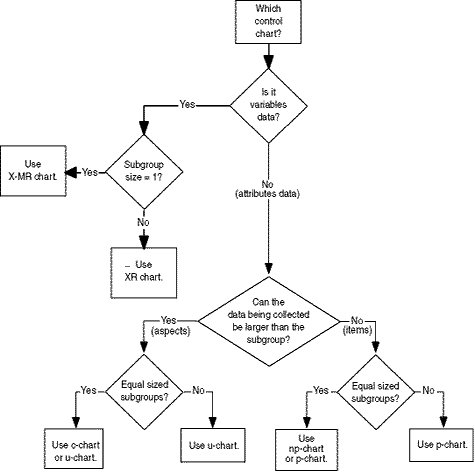
Correct control chart selection is a critical part of creating a control chart. If the wrong control chart is selected, the control limits will not be correct for the data. The type of control chart required is determined by the type of data to be plotted and the format in which it is collected. Data collected is either in variables or attributes format, and the amount of data contained in each sample (subgroup) collected is specified.
Variables data is defined as a measurement such as height, weight, time, or length. Monetary values are also variables data. Generally, a measuring device such as a weighing scale, vernier, or clock produces this data. Another characteristic of variables data is that it can contain decimal places e.g. 3.4, 8.2.
Attributes data is defined as a count such as the number of employees, the number of errors, the number of defective products, or the number of phone calls. A standard is set, and then an assessment is made to establish if the standard has been met. The number of times the standard is either met or not is the count. Attributes data never contains decimal places when it is collected, it is always whole numbers, e.g. 2, 15.
Sample or subgroup size is defined as the amount of data collected at one time. This is best explained through examples.
- When assessing the temperature in a vat of liquid, the reading is measured once hourly; therefore the sample size is one per hour.
- When measuring the height of parts, a sample of five parts is taken and measured every 15 minutes; therefore the sample size is five.
- When checking the number of phone calls that ring more than three times before being answered, the sample size is the total number of phone calls received, which will vary.
- When checking 10 invoices per day for errors, the sample size is 10.
More information on types of data, sample sizes, and how to select them is given in Practical Tools for Continuous Improvement which is available from PQ Systems. Once the type of data and the sample size are known, the correct control chart can be selected. Use the following “Control chart selection flow chart” to choose the most appropriate chart.
Once you’ve determined which control chart is appropriate, software like SQCpack can be used to create the chart.