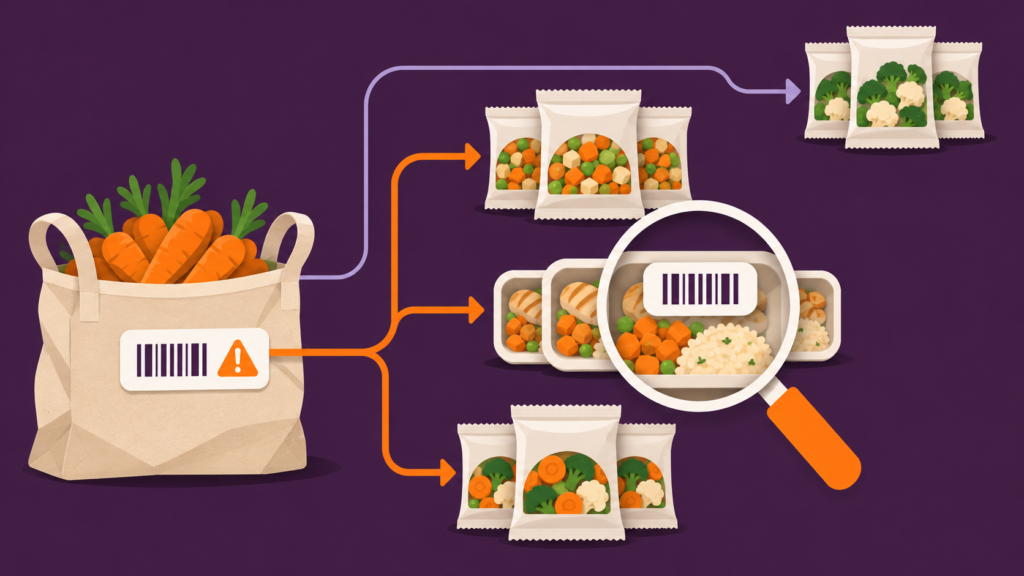
Every food processor already knows recalls are a risk of doing business. What’s changing is the scale of the exposure—and how quickly an issue originating at one point in the supply chain can become a problem for manufacturers downstream.
Food recall activity remained elevated in 2025. According to an analysis reported by Food Safety Magazine, FDA and USDA issued a combined 320 food recall announcements in 2025, compared with 296 in 2024. FDA announcements increased from 241 to 253, while USDA announcements rose from 55 to 71. Undeclared allergens were the most common reason for recall announcements, followed by microbiological contamination.
But recall frequency only tells part of the story.
Fewer Recalls Don’t Necessarily Mean Less Exposure
The first quarter of 2026 illustrated why manufacturers also need to pay attention to recall volume.
According to Sedgwick’s Q1 2026 U.S. Product Safety and Recall Index findings, recall events across the five industries it tracks declined 10.5% from the previous quarter, from 877 to 785. Yet the total number of defective products recalled across those industries increased 27% to 492 million units.
Food showed its own version of that scale problem. FDA-regulated food recalls affected approximately 57.4 million units in Q1 2026, nearly double the 28.76 million units recalled during Q4 2025—a quarter-over-quarter increase of approximately 99.5%. USDA-regulated food recalls meanwhile accounted for 37.1 million pounds of product, the third-highest quarterly total in more than two decades.
That distinction matters. A manufacturer can face fewer recall events overall while still confronting recalls that affect enormous amounts of product. And one event can be enough.
One Ingredient Problem Can Become Many Finished-Product Problems
Modern food production creates interconnected supply chains. Ingredients received from one supplier may enter multiple production runs, SKUs, facilities, customers, or brands. When an upstream ingredient is implicated, identifying exactly where it went becomes critical.
A 2026 recall provides a particularly clear example. A frozen food manufacturer recall associated with foreign material in a carrot ingredient ultimately expanded to 16 products totaling nearly 37 million pounds. Reporting FSIS information showed that the affected ingredient moved through three establishments and multiple product lines and appeared in products sold under five brands.
That is the practical problem lot traceability is intended to solve.
When an ingredient is implicated, the question isn’t simply, Did we receive it? The manufacturer needs to establish:
Which supplier lot did we receive? Which production runs consumed it? Which finished-product lots did those runs create? Where are those finished lots now? Which customers received them?
Without dependable lot-level records, answering those questions can turn into an investigation spanning receiving records, production paperwork, inventory transactions, spreadsheets, shipping documents, and employee knowledge.
With connected lot records, the organization can work from a documented chain of product movement instead.
That can change the objective of a recall from “find everything that might be affected” to “identify precisely what is affected.”
Recall Speed is Really About Recall Precision
Speed matters during a recall, but not simply because a faster search saves labor.
The real goal is to reduce uncertainty.
When a manufacturer can’t quickly establish the relationship between an incoming ingredient and outgoing finished goods, it may have to investigate or hold a broader population of inventory while the scope is determined. Accurate lot genealogy gives QA and operations teams better information for defining that scope.
That means traceability can support several decisions at once: identifying potentially affected inventory, determining where finished goods were shipped, communicating with customers, documenting the investigation, and helping operations understand which product isn’t implicated.
FDA makes essentially the same connection in its rationale for enhanced food traceability. The agency says the Food Traceability Rule is intended to enable faster identification and rapid removal of potentially contaminated food.
For processors, that makes traceability more than a recordkeeping exercise. It becomes part of operational risk management.
FSMA 204 Adds Another Reason to Look Closely at Traceability
There is also an important regulatory backdrop.
FDA’s Food Traceability Rule – commonly associated with Section 204 of FSMA – establishes additional recordkeeping requirements for organizations that manufacture, process, pack, or hold foods on the agency’s Food Traceability List.
At its core, the rule requires covered organizations to maintain Key Data Elements (KDEs) associated with specific Critical Tracking Events (CTEs). Depending on the operation, those events can include activities such as receiving, transformation and shipping. In certain situations, covered entities must also be capable of providing required traceability information to FDA within 24 hours or another reasonable timeframe agreed to by the agency. FDA provides the requirements and supporting resources here.
The timing deserves some nuance.
The original compliance date was January 20, 2026. The FDA subsequently proposed extending it 30 months. Congress later directed the FDA not to enforce the Food Traceability Rule before July 20, 2028. FDA says it intends to comply with that directive.
That additional time gives manufacturers more runway. It doesn’t change the underlying operational case for traceability.
In fact, FDA has emphasized that implementing the rule requires coordination among supply-chain partners because traceability information has to move between organizations, not simply exist inside one facility.
For manufacturers evaluating readiness, that makes the next two years an opportunity to ask a more useful question than “How long do we have?”
How well could our current process answer a lot-level question today?
Don’t Wait for a Recall to Test the Answer
A traceability process is difficult to evaluate on paper alone. The better test is operational.
Choose an ingredient lot and follow it forward. Identify every production run in which it was consumed, every finished-good lot it became part of, and every destination to which those finished goods were shipped.
Then reverse the exercise. Start with a finished-product lot and determine every relevant ingredient lot and production event behind it. And time both exercises.
If completing the trace requires searching paper records, reconciling spreadsheets, rekeying information, or finding the one employee who knows where a particular record lives, you’ve identified more than an administrative inconvenience. You’ve found a potential constraint on recall response.
For ParityFactory customers, digital lot records already provide a foundation for answering these questions. The opportunity is to make sure the processes surrounding that technology are still capturing the information your team expects them to capture.
Production changes. New SKUs are introduced. Employees change roles. Lines and workflows evolve. Manual workarounds can creep into an otherwise digital operation.
That’s why recall readiness shouldn’t be treated as something established once during implementation. It should be tested periodically against the operation that exists today.
Traceability is Valuable Before Anyone Asks for the Records
FSMA 204 makes traceability a regulatory priority for covered foods. Rising recall volumes make it an operational one.
The manufacturers best prepared for both won’t necessarily be the organizations that spend the next two years checking boxes against a deadline. They’ll be the ones that use that time to understand how quickly and confidently they can follow a lot through their operation,from receiving through production and ultimately to the customer.
Because when a supplier calls with a problem, the first question isn’t going to be whether your compliance project is finished. It’s going to be: Where did that lot go?