How do I choose the appropriate type of control chart?

April 26, 2019
2 min read
General

Proper control chart selection is critical to realizing the benefits of Statistical Process Control.

Many factors should be considered when choosing a control chart for a given application. These include:

  • The type of data being charted (continuous or attribute)
  • The required sensitivity (size of the change to be detected) of the chart
  • Whether the chart includes data from multiple locations or not
  • The ease and cost of sampling
  • Production volumes

WinSPC Means Lower Costs and Higher Quality

WinSPC is software to help manufacturers create the highest quality product for the lowest possible cost. You can learn more here.

For variable data, X-Bar and R (or X-Bar and S) charts are very common, however there are cases when they are not appropriate. For example, charts for multiple locations within the subgroup are utilized when a subgroup consists of measurements that may come from different distributions. Examples include:

– Multiple measurements on the same unit (e.g. diameter in 3 places)
– Units produced during the same cycle from different cavities, machining locations, filling heads, etc.

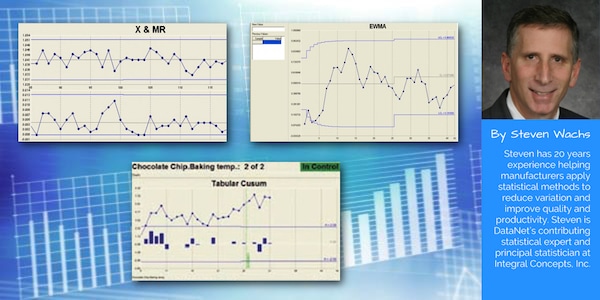
When sampling is costly, when within-sample variation is negligible, or when the detection of “small” process changes is unnecessary, charts of individual measurements are often utilized. EWMA and CUSUM charts are useful when charting individual measurements but the traditional Individuals/Moving Range charts do not provide adequate sensitivity (ability to detect process changes when they occur).

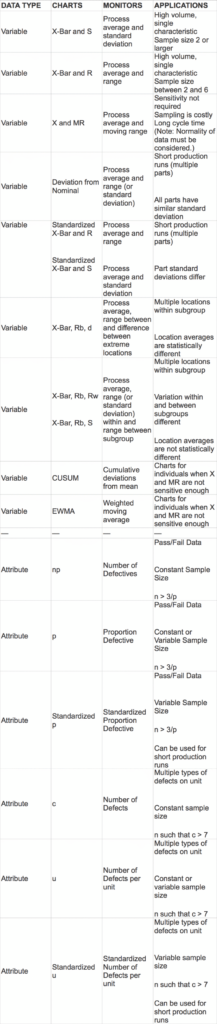
The following table may be utilized to help select an appropriate control chart for each application. The charts are segregated by data type. Charts for variable data are listed first, followed by charts for attribute data.
Steven Wachs, Principal Statistician
Integral Concepts, Inc.

Integral Concepts provides consulting services and training in the application of quantitative methods to understand, predict, and optimize product designs, manufacturing operations, and product reliability. www.integral-concepts.com


 Download the white paper on how to jump-start a “mini” Six Sigma Quality program on a budget

Grace Barton Avatar

Grace Barton

Marketing Specialist

Grace Barton is a digital marketing and competitive intelligence professional who crafts strategic narratives by bridging marketing insights with analytical expertise. At Advantive, she creates engaging, data-driven content tailored to the distribution, manufacturing, packaging, and quality industries. Her goal is to deliver impactful messaging that drives engagement and growth based on specific gap closure needs, whether responding to sales organization requirements, pinpointing gaps in content, or meeting immediate market trends.
She thrives on transforming competitive intelligence into actionable insights for the sales organization. Grace manages Advantive's competitive intelligence platform, Klue, to equip the sales team with the battlecards and market data they need to stay ahead of competitors. Since launch, she's built 28+ battlecards across four lines of business, ensuring the GTM strategy stays sharp.
Grace has a passion for leveraging market insights with storytelling to guide strategic decision-making, empower sales organizations, and nurture organizational growth.

Areas of Expertise: Digital Marketing, Competitive Intelligence, Strategic Narratives, Marketing Insights, Analytical Expertise
Fact Checked & Editorial Guidelines

Our Fact Checking Process

We prioritize accuracy and integrity in our content. Here's how we maintain high standards:
  1. Expert Review: All articles are reviewed by subject matter experts.
  2. Source Validation: Information is backed by credible, up-to-date sources.
  3. Transparency: We clearly cite references and disclose potential conflicts.
Your trust is important. Learn more about our Fact Checking process and editorial policy.
Reviewed by: Subject Matter Experts

Our Review Board

Our content is carefully reviewed by experienced professionals to ensure accuracy and relevance.
  • Qualified Experts: Each article is assessed by specialists with field-specific knowledge.
  • Up-to-date Insights: We incorporate the latest research, trends, and standards.
  • Commitment to Quality: Reviewers ensure clarity, correctness, and completeness.
Look for the expert-reviewed label to read content you can trust.