Adobe acquired Magento for $1.68B in May 2018, giving them the missing eCommerce platform piece for both B2C and B2B. They made the purchase to replace the aging Business Catalyst platform they bought in 2009, which they sunset in September 2021. Magento, now Adobe Commerce, was meant to be a key player in the eCommerce space. However, the platform has faced significant challenges, particularly in the B2B space.
Let’s examine the limitations of Adobe Commerce and illustrate why a purpose-built B2B commerce platform, like Pepperi, is the best option for wholesalers and distributors.
A Practical Look at Adobe Commerce for B2B
It was a bold move for Adobe to acquire Magento, and while Adobe has attempted to address these issues, the costs and complexities involved remain substantial, particularly with:
- Legacy on-premises architecture: Can lead to performance bottlenecks, especially for high-traffic B2B operations with complex catalogs and ordering processes.
- Headless deployments: Limit access to out-of-the-box features and integrations, forcing businesses to rely heavily on custom development.
- Incomplete B2B functionality: Reliance on numerous extensions to achieve comprehensive B2B functionality, indicating a dedicated core feature set.
- Cost concerns: High costs associated with licensing, implementation, and maintenance raise concerns about long-term value.
Limitations & Shortcomings of Adobe Commerce
Adobe Commerce falls short in several key areas crucial for success in B2B eCommerce:
- Complexity: It is difficult to implement and manage Adobe Commerce in a headless configuration, where the front-end of a B2B online store is separated from the back-end system. The software demands significant technical expertise and resources.
- High Cost: Adobe Commerce has high licensing fees, implementation costs, and ongoing maintenance that can limit many businesses.
- Not Purpose-Built for B2B: Limited native B2B functionality and slow development in this area indicates that Adobe is more focused on a more traditional retail audience, B2C, and DTC retailers.
- Difficult Upgrades: Upgrading Adobe Commerce can be complex and time-consuming, which can hinder business agility.
Can Your Distribution Business Meet the Rising Customer Expectations?
Read moreWhy Seek a Purpose-Built B2B Commerce Platform?
Many B2C businesses choose the same vendor when they expand into the B2B commerce space. The main benefit is having the convenience of a shared product catalog. However, this is not just about sticking with your current vendor because of a few B2B features.
Instead, it’s crucial to consider purpose-built B2B commerce solutions that demonstrate a deep understanding of the unique needs and requirements of B2B businesses. A B2B eCommerce platform can meet the specific needs of different B2B stakeholders, like sales reps, buyers, van sales, and customer support.
Pepperi is built with B2B requirements in mind and emerges as a strong B2B eCommerce contender with unique strengths that distinguish it from Adobe Commerce, formerly Magento.
Key B2B Feature Comparison
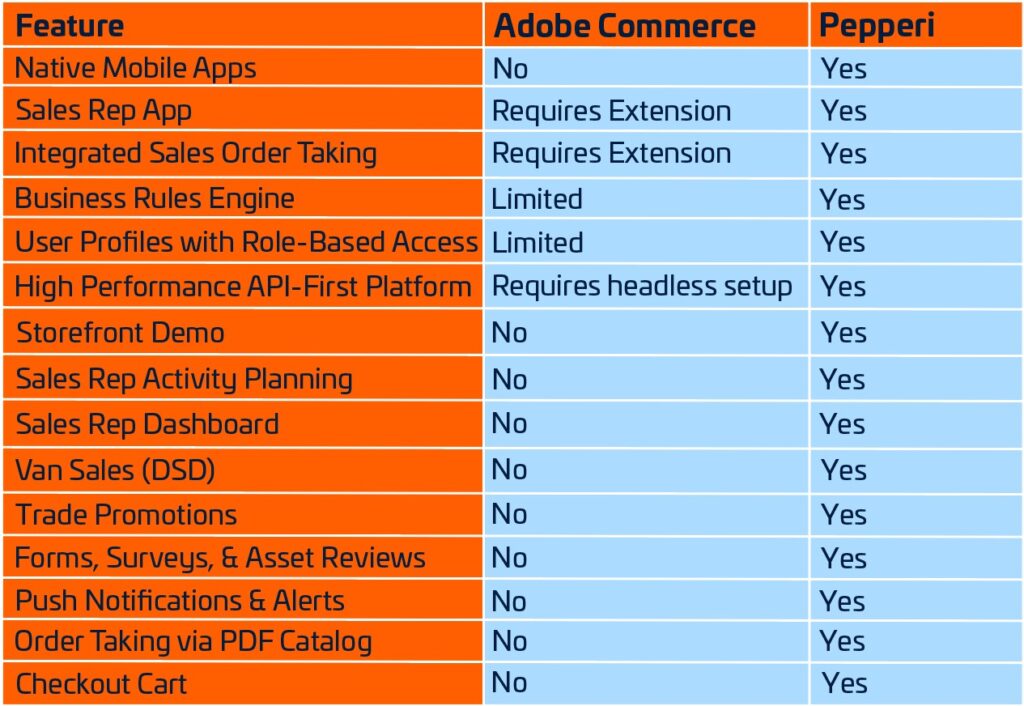
Let’s look at Adobe Commerce and Pepperi’s Unified B2B Commerce platforms and compare their features across several different parameters.
Standout Features of Pepperi
This comparison makes it apparent that Pepperi is built with B2B requirements in mind and emerges as a robust B2B eCommerce solution. Here’s what makes Pepperi stand out from Adobe Commerce:
User Profiles
Pepperi’s advanced user profile management allows administrators to define roles, permissions, and workflows for different user groups. This ensures that each user has access to the specific tools and information they need, improving efficiency and security. Although Adobe Commerce allows buyers to manage purchases on behalf of multiple customers and switch between accounts, Pepperi’s user profiles offer more comprehensive control and flexibility.
Business Rules Engine
Pepperi boasts a robust Business Rules Engine. It enables businesses to automate complex processes and enforce business logic. This includes dynamic pricing, promotions, order approvals, and more, providing flexibility and control over your operations. While Adobe Commerce’s flexibility allows for extensive customization, it comes at a high cost. This heavy reliance on development can lead to expensive, complex, and time-consuming implementations.
Native Mobile & Web Apps
Pepperi offers dedicated mobile and web apps for both sales reps and B2B buyers. These apps provide a seamless and consistent experience across all devices, online and offline. Sales reps can take orders on the go, even without internet connectivity, while buyers enjoy a user-friendly online ordering experience. Adobe Commerce relies primarily on responsive web design, so it lacks the performance and offline capabilities of Pepperi’s native mobile and web apps.
Sales Rep App
Adobe Commerce lacks a dedicated portal for sales representatives. Instead, sales reps and customer service reps log in as their customer. However, Pepperi provides comprehensive solutions for both sales representatives and buyers. Sales reps can use the platform to manage orders, access customer data, and conduct in-person or virtual sales meetings effectively.
Single Back Office for Sales Reps & B2B Commerce
Though Adobe Commerce provides a unified platform for managing B2B and B2C storefronts, Pepperi goes a step further by providing a unified platform for both sales reps and B2B eCommerce. It allows your business to streamline operations and enhance communication. Sales reps and online buyers access the same information and tools, ensuring a consistent experience and simplifying order management. This level of integration is often not possible in Adobe Commerce, where sales reps may rely on separate systems and potentially outdated information.
Cross-Platform Infrastructure (CPI)
Pepperi’s cross-platform infrastructure (CPI) ensures new features and updates are rolled out seamlessly across all devices (Android, iOS, and web) with no system downtime or complex upgrades. The CPI allows Pepperi to continuously innovate and deliver value quickly. Adobe Commerce requires extensive development for even basic customizations, while Pepperi’s highly configurable platform minimizes the need for costly and time-consuming custom development. This translates to quicker implementation, reduced costs, and greater flexibility for your business.
Performance & Integration
Pepperi leverages local data storage to deliver lightning-fast user response times, unlike Adobe Commerce which often requires retrieving data from the source each time it refreshes, potentially leading to slower performance.
Pepperi also offers seamless integration with its native iPaaS, making it easier to connect to other business systems without complex API development. As a true SaaS platform, Pepperi can manage all upgrades and maintenance, allowing you to free up your IT resources.
Embrace Purpose-Built with Pepperi
While Adobe Commerce continues to be a significant player in the eCommerce landscape, its limitation – particularly for B2B businesses – becomes increasingly apparent. Its complex architecture, high costs, and lack of focus on B2B functionality make it a less desirable option for wholesalers and distributors.
Pepperi, on the other hand, is designed specifically for the B2B market, providing a broader range of B2B features. It has a comprehensive feature set, user-friendly interface, and focus on performance and scalability that empowers businesses to streamline their operations, enhance customer experiences, and drive growth. Pepperi is the clear choice for B2B businesses seeking a reliable, scalable, and cost-effective eCommerce solution.

Our Fact Checking Process
We prioritize accuracy and integrity in our content. Here's how we maintain high standards:- Expert Review: All articles are reviewed by subject matter experts.
- Source Validation: Information is backed by credible, up-to-date sources.
- Transparency: We clearly cite references and disclose potential conflicts.
Our Review Board
Our content is carefully reviewed by experienced professionals to ensure accuracy and relevance.- Qualified Experts: Each article is assessed by specialists with field-specific knowledge.
- Up-to-date Insights: We incorporate the latest research, trends, and standards.
- Commitment to Quality: Reviewers ensure clarity, correctness, and completeness.