The difference between run charts and control charts

December 3, 2009
2 min read
General

A customer recently asked one of our support representatives the following questions: What is the difference between a run chart and a control chart? And when should I use one vs. the other? These are great questions because they allow us to highlight some of the benefits of control charts.

When you create any chart, you are typically trying to answer a question. For example, you might be asking, “Has my process improved?” or, “Has my process gotten worse?”  You might be asking, “How is the process running today compared to yesterday?” Before you decide on using a run chart or a control chart, consider the type of question you want to answer.

A run chart is the simplest of charts. It is a single line plotting some value over time. A run chart can help you spot upward and downward trends and it can show you a general picture of a process.
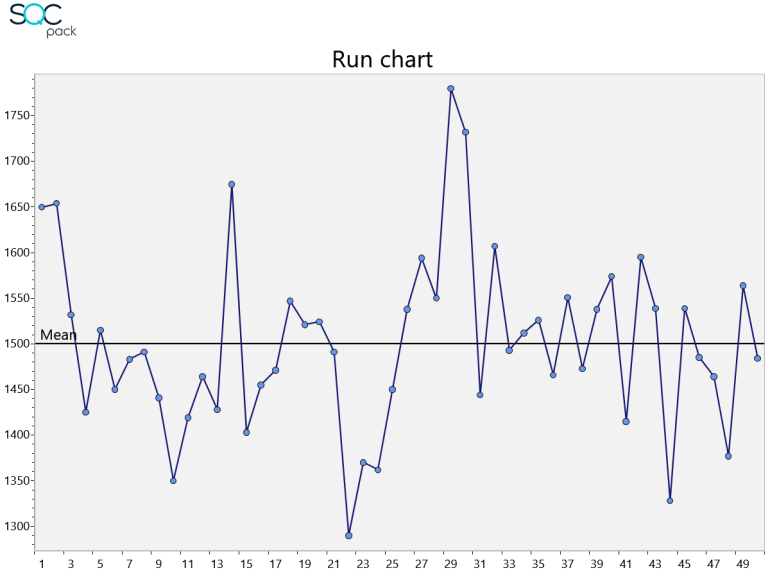
A control chart also plots a single line of data over time. However, control charts include upper and lower control limit lines with a centerline. These lines are calculated based on the data being plotted, and this allows you to answer more questions about the process. For example, you can ask the question, “Is my process stable or in control?” If any of your data is outside the limit lines, the answer is, “No. Your process is not stable.” You would then know that system changes may be required to make it stable.
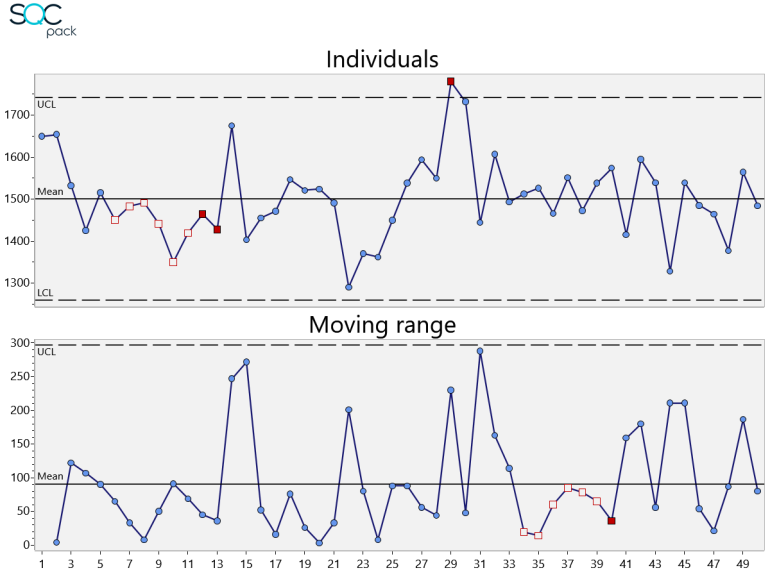
Control charts are designed to prevent two common mistakes: 1) adjusting the process when it should be left alone; and 2) ignoring the process when it may need to be adjusted. Run charts lack the benefit of statistical control limits. So, if they are used to adjust your process, this may add more variation to the process instead of reducing the variation.

Both run charts and control charts are helpful, but depending on your goals, control charts generally provide more specific information and insight into your process.

Grace Barton Avatar

Grace Barton

Marketing Specialist

Grace Barton is a digital marketing and competitive intelligence professional who crafts strategic narratives by bridging marketing insights with analytical expertise. At Advantive, she creates engaging, data-driven content tailored to the distribution, manufacturing, packaging, and quality industries. Her goal is to deliver impactful messaging that drives engagement and growth based on specific gap closure needs, whether responding to sales organization requirements, pinpointing gaps in content, or meeting immediate market trends.
She thrives on transforming competitive intelligence into actionable insights for the sales organization. Grace manages Advantive's competitive intelligence platform, Klue, to equip the sales team with the battlecards and market data they need to stay ahead of competitors. Since launch, she's built 28+ battlecards across four lines of business, ensuring the GTM strategy stays sharp.
Grace has a passion for leveraging market insights with storytelling to guide strategic decision-making, empower sales organizations, and nurture organizational growth.

Areas of Expertise: Digital Marketing, Competitive Intelligence, Strategic Narratives, Marketing Insights, Analytical Expertise
Fact Checked & Editorial Guidelines

Our Fact Checking Process

We prioritize accuracy and integrity in our content. Here's how we maintain high standards:
  1. Expert Review: All articles are reviewed by subject matter experts.
  2. Source Validation: Information is backed by credible, up-to-date sources.
  3. Transparency: We clearly cite references and disclose potential conflicts.
Your trust is important. Learn more about our Fact Checking process and editorial policy.
Reviewed by: Subject Matter Experts

Our Review Board

Our content is carefully reviewed by experienced professionals to ensure accuracy and relevance.
  • Qualified Experts: Each article is assessed by specialists with field-specific knowledge.
  • Up-to-date Insights: We incorporate the latest research, trends, and standards.
  • Commitment to Quality: Reviewers ensure clarity, correctness, and completeness.
Look for the expert-reviewed label to read content you can trust.