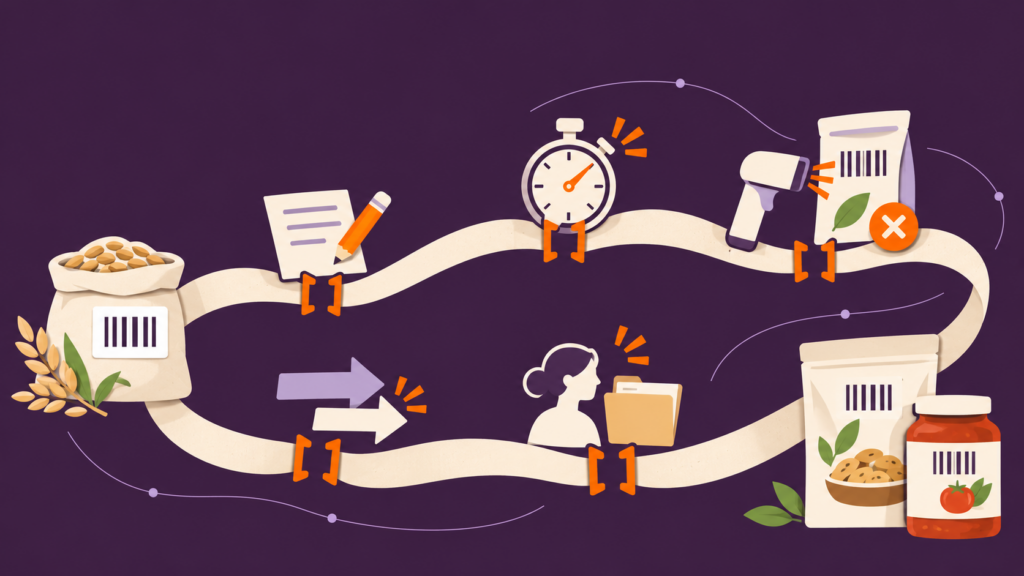
Most food and beverage manufacturers have some form of lot traceability in place. The bigger question is whether that process works consistently from receiving through production, inventory, rework and shipping—and whether it still works the way you think it does.
That’s where traceability gaps tend to matter.
A process can perform well during normal production while still containing a manual handoff, outdated workflow, missing data point or dependency on one experienced employee. Those weaknesses may be easy to work around on an ordinary day. During a recall, when the team needs to establish exactly where an ingredient came from, what it went into and where the resulting product was shipped, they become much more important.
In fact, USDA guidance recommends conducting periodic mock recalls specifically to test internal tracking systems, while food-industry guidance emphasizes reviewing mock recalls as part of a continuous-improvement process.
So how do you know whether your existing lot traceability process has a weak point?
Start with these five signs.
1. A Manual Step Still Exists Somewhere in the Process
A traceability process doesn’t have to be completely paper based to have a paper problem.
You might scan ingredients when they’re received and finished goods when they’re shipped, for example, but still rely on a handwritten record during production, rework or repacking. Perhaps a spreadsheet bridges two processes that were never fully connected. Or an employee records information on paper during a shift and enters it into another system later.
Each handoff creates another place where information has to be recorded, interpreted or re-entered correctly.
That matters because traceability depends on maintaining connections between material as it changes throughout production. Food Engineering, for example, emphasizes the need to document raw materials, ingredients and packaging and accurately record what is actually used in production. It also identifies barcoding as one-way processors can improve that documentation. (Food Engineering)
What to check: Walk one lot through your operation from receiving to shipping. At every handoff, ask how its identity is captured. Look especially closely at rework, repacking, partial quantities, mixed pallets and other exceptions to the standard production flow.
If someone has to write something down now so another person can enter it somewhere else later, you’ve found a step worth investigating.
2. Nobody Can Say How Long a Mock Recall Would Take
Ask your team a simple question:
How long would it take us to trace a lot right now?
“We could do it” isn’t the same answer as “we’ve tested it.”
A mock recall turns confidence into evidence. USDA guidance recommends recording the start and end time of the exercise, evaluating whether it met a predetermined timeframe and identifying weaknesses requiring corrective action. It also recommends reconciling the quantity received against product located in inventory, production and other destinations. (USDA mock recall guidance)
For manufacturers, the exercise should test both directions: Can you start with an incoming ingredient lot and determine what finished goods it entered and where those products went? And can you start with a finished lot and work backward to the relevant ingredients and production records?
Industry guidance commonly uses defined time and recovery targets for these exercises. Food Engineering, for example, notes that processors often establish mock-recall targets around complete product accounting within a defined period. (Food Engineering)
What to check: Pick a lot, start the clock and run the exercise using the people and processes you would actually depend on.
Record both how long it takes and how completely you can account for the product. Speed without accuracy isn’t a successful trace.
3. Errors Aren’t Caught at the Point of Activity
Lot traceability is often discussed as the ability to reconstruct what happened after the fact. But a connected digital process can also help manufacturers catch certain mistakes while production is happening.
Consider ingredient verification. If an operator scans a material before adding it to a batch, the system can compare that material against what the production process calls for. When the wrong ingredient is scanned, the operator can receive an immediate notification rather than discovering the problem after the product has already moved farther through production.
That isn’t just theoretical. Food Engineering describes ingredient verification as an example of how manufacturing execution systems can introduce safeguards during production: material is scanned before being added to a batch, and an incorrect ingredient can generate an immediate notification. The article contrasts that with discovering the error later through finished-product testing.
The same principle applies elsewhere in a food manufacturing operation. Barcode and verification technologies can compare materials, packaging, labels or other production information against what is expected for a particular product or run. Food Engineering has also documented real-time barcode and MES verification used to identify incorrect labels and provide immediate pass/fail feedback.
The distinction is important: traceability tells you what happened; validation can help you catch a mismatch before it becomes a larger problem.
What to check: Look at the points where employees scan ingredients, materials or finished goods. What happens when someone scans the wrong item? Does the workflow immediately flag the mismatch? Does the employee receive clear information about what needs to be corrected? Or is the mistake likely to surface later during QA review, inventory reconciliation or another downstream process?
If your system is capturing the transaction but your team doesn’t learn about an error until later, there may be an opportunity to make the information you’re already collecting more useful at the point of work.
4. The Process Hasn’t Been Revisited Since Something Changed on the Floor
Traceability processes don’t operate in a static environment.
New SKUs get introduced. Suppliers change. Production lines are added or reconfigured. Packaging changes. Rework procedures evolve. Employees move into new roles. A process that accurately represented the plant at implementation can gradually stop representing the plant that exists today.
This is one reason mock recalls are useful beyond audit preparation. A realistic exercise can expose weaknesses in procedures, records and responsibilities that aren’t obvious during routine production. USDA’s current mock-recall guidance explicitly recommends identifying weaknesses after an exercise and using the findings to revise procedures or provide additional staff training. (USDA)
What to check: Think about the last significant operational change your facility made. Was the traceability workflow reviewed at the same time?
If you’ve added a product, supplier, line, warehouse location or new process without asking how lot information moves through it, put that area near the top of your list.
Traceability shouldn’t describe the facility you had at go-live. It needs to describe the facility you’re operating today.
5. A New Employee Couldn’t Run a Lot Trace Without Help
Every operation has experienced employees who know how things really work.
That’s valuable—until critical traceability information depends on them being available.
A strong recall process should define responsibilities, maintain current information and train the people expected to execute it. Food Engineering’s recall-program guidance specifically recommends procedures for training recall-team members and their backups, along with documented mock-recall procedures. (Food Engineering)
That’s an important distinction between institutional knowledge and a repeatable process.
If someone tracing a lot needs to ask, “Who knows where that spreadsheet is?” or “Who normally handles this?” the process contains a human dependency that may become a bottleneck during a real event.
What to check: Give the exercise to someone who understands your operation but isn’t your resident traceability expert.
Can they identify the correct lot? Trace it backward and forward? Locate the necessary records? Reconcile the quantities? And explain what they would do next?
If they can’t, don’t assume the employee needs more experience. First ask whether the process itself provides enough guidance.
Finding a Gap Doesn’t Mean Starting Over
The point of this exercise isn’t to prove that your traceability process is perfect.
It’s to find the weak points before an actual recall finds them for you.
A manual handoff might need to be digitized. A workflow might need to reflect a new production process. Scan validation may need to be configured differently. A procedure might need documentation. Employees may simply need another round of training or a mock recall to become comfortable with their roles.
The encouraging part is that none of those findings automatically means replacing your traceability system.
For customers, the better first question is often: Are we getting everything we can from the capabilities we already have?
Try a simple test with your team. Choose a lot at random. Trace it backward to its source and forward through production to its destination. Time the exercise. Reconcile the quantities. Note every place where someone has to leave the normal workflow, search another source or ask someone else what to do.
Those moments are your gap list.
And once you know where the gaps are, you know where to start improving.